

October 30, 2025

Bhagyashree Prabhutendolkar
People often ask me, “How do you actually learn through travel? What do you really learn at Baret?”
I always smile — because how exactly do you encapsulate something that can’t be measured in grades or captured in a classroom? At Baret, learning doesn’t just happen in lectures or books. It happens in the smallest, most human ways — in shared meals, moments of confusion, laughter that crosses languages, and in kindness that needs no translation.
One of those moments came during our side quest to Rio de Janeiro — when four of us, from four very different corners of the world, set off together: Ahmed from Pakistan, Jiaxin and Jackie from China, and me from India.
Back home, my circle was mostly Indian. Familiar faces, shared jokes, the same cultural lens — and the same unconscious biases. I had grown up hearing things like, “Don’t talk to anyone from Pakistan,” or “Never trust Chinese goods.” These ideas lived quietly in the background, never questioned, never challenged.
Until Baret happened — and suddenly, I was sitting next to the very people I was told to avoid, on a long bus ride to Rio.
“Rio la la la, Rio la la la!” We sang as the bus rolled out of São Paulo, brimming with excitement. That enthusiasm dimmed briefly when we were stopped for not carrying our passports. They were at the consulate for visa processing, and our explanations in broken Portuguese didn’t help. As we stumbled over Google translate, Jackie from China calmly stepped forward and handled the situation with such patience that even the officer smiled and let us through. And just like that, we were on our way — a small crisis already teaching us something about composure, teamwork, and trust.
On that journey, care became a quiet language of its own. Someone made sure no one got left behind at rest stops. Someone offered a snack when another’s card didn’t work. Someone carried medicine when someone else felt dizzy. It was so ordinary — and yet so extraordinary to be there for each other as humans first, beyond all our labels and identities.
When we finally reached our Airbnb, the reality hit: the rooms were much smaller than in the pictures (classic travel catfish!). The girls took the bed; the boys took the couch. Sheets were shared, bottles were refilled, and every chore — from cleaning to cooking — became a collective ritual and we figured it out together.
That night, on Rio’s balcony under the vast Brazilian sky, Jiaxin played a song called “A Letter from My Grandfather.”
Her voice trembled slightly as she translated the lyrics for us:
“Now it’s three in the afternoon.
I’m lying in a room I don’t recognize.
My journey on this planet is about to end.
The doctor says… maybe by next season.”
She told us softly, “This song reminds me of my grandfather. He had Alzheimer’s. In his last days, he couldn’t remember me. But he was my best friend since kindergarten.”
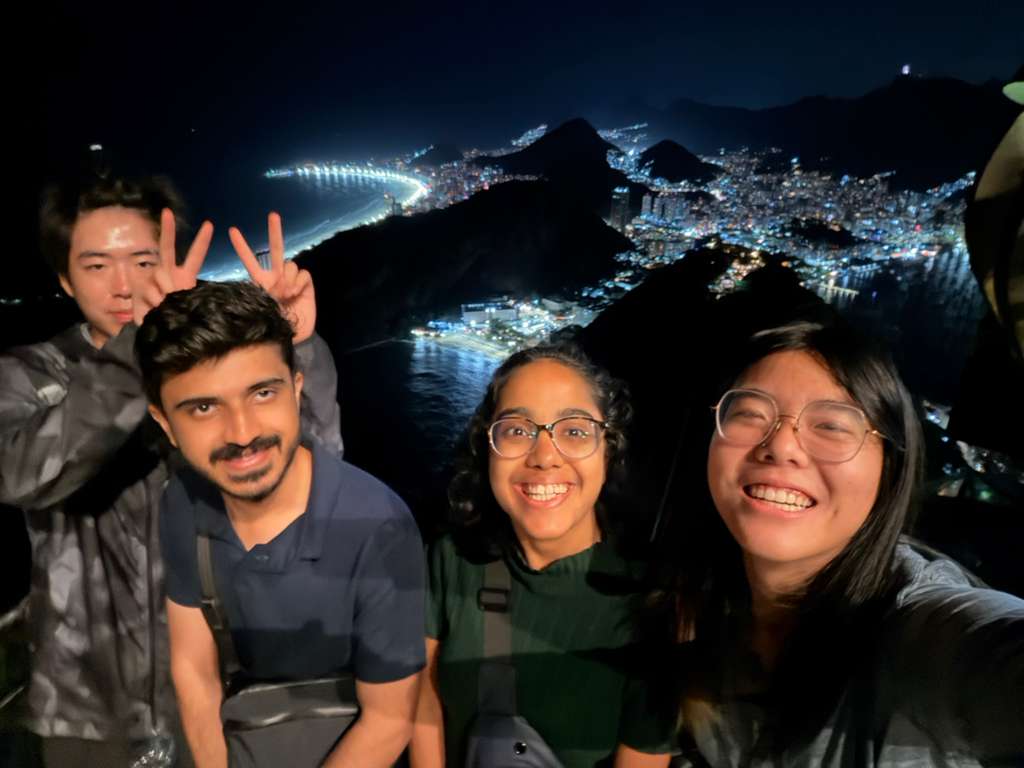
As the song played, silence fell over us. We didn’t speak. We didn’t need to. The music carried our shared ache — her grief, my nostalgia, Ahmed’s quiet reflection, Jackie’s gentle nod. It was one of those rare human moments where all you share is sacred silence, and yet it’s heard and understood.
The next day, while hiking to Christ the Redeemer, I lagged behind, half breathless, half tired. I told Jackie, “You all go ahead. I’ll catch up.”
He looked back and said, “No. Leave no one behind.”
And so we climbed — slowly, together — sharing water, laughter, and the weight of each other’s bags. That became our unspoken rule for the rest of the trip: leave no one behind. On the beach, on the streets, in the waves — we always moved together. “Are you tired?” someone would ask. “Here, hold my hand.” “Hungry?” “Let’s grab food first.” “Scared to ride the waves?” “I’ll go with you.”
In those small, tender exchanges, I learnt more about empathy than any course could ever teach me. I realised how human connection quietly dissolves borders. People are never their passports, never the headlines or stereotypes written about their countries. Back at home, I would have never talked to someone from Pakistan or China; lest go on a trip with them. But Baret burst my bubble and took me to the core of human connection.
That’s what Baret does — it breaks your bubbles and gives you the kind of learning no textbook could ever offer. It gives you a front-row seat to humanity. It shows you that cultural understanding isn’t a subject; but a way of being when met with open eyes and an open heart.
As we rode back from Rio, Jiaxin softly sang again —
“If one day you miss me,
Go to the seaside.
The wind that brushes your face —
That’s my hand, touching you gently once more.”
And as the city lights faded behind us, I realised that’s what learning at Baret feels like — The wind that touches your face softly, Leaving you a little changed, a little more human than before.

NEW YORK
SAO PAULO
PARIS
ISTANBUL
NAIROBI
DELHI
BEIJING


