

March 6, 2026
.jpg)
On their Fellowship, Mountains, Markets & Memory in Marrakech & the High Atlas, led by Weronika Brzezinska and Luis Haddad, a group of ten Scholars began in Morocco's cultural hub of Marrakech.
After its iconic markets, mashrabiya trellis windows and ubiquitous mint tea, they drove through the Sahara into the High Atlas Mountains to bond, learn, and exchange with the indigenous Imazighen.
Each Baret Fellowship is its own immersive, educational experience. Our Scholars go on dozens upon dozens of Fellowships just like this one, all around the world.
The High Atlas—home to Imazighen communities—are where terraced fields, earthen dwellings, and mountain trails reveal enduring bonds between people and land. Though the city and the villages in the foothills of the mountains share a state and a culture, to an extent, they reveal different ways of being in the world.
After the hustle and bustle of Marrakech, the Atlas Mountains, in their grandeur and quiet remove, were a bit of a shock. We spoke with three Scholars, Ahmed, from Pakistan, Sofia, from Spain, and Isabella, from Wales, about their experience.
They all agreed on one thing: the breathtaking diversity of landscapes and biomes. “The landscapes throughout the week felt almost surreal,” said Sofia. “You’d wake up and see these huge mountains covered in snow, and the sun would reflect off them with this pinkish tint. It was just gorgeous.”
“In one week, we saw semi-deserts, rural villages, snow-covered mountains with two-meter snowbanks. All of those landscapes coexisted within a few hundred kilometers. It was mind-blowing.”
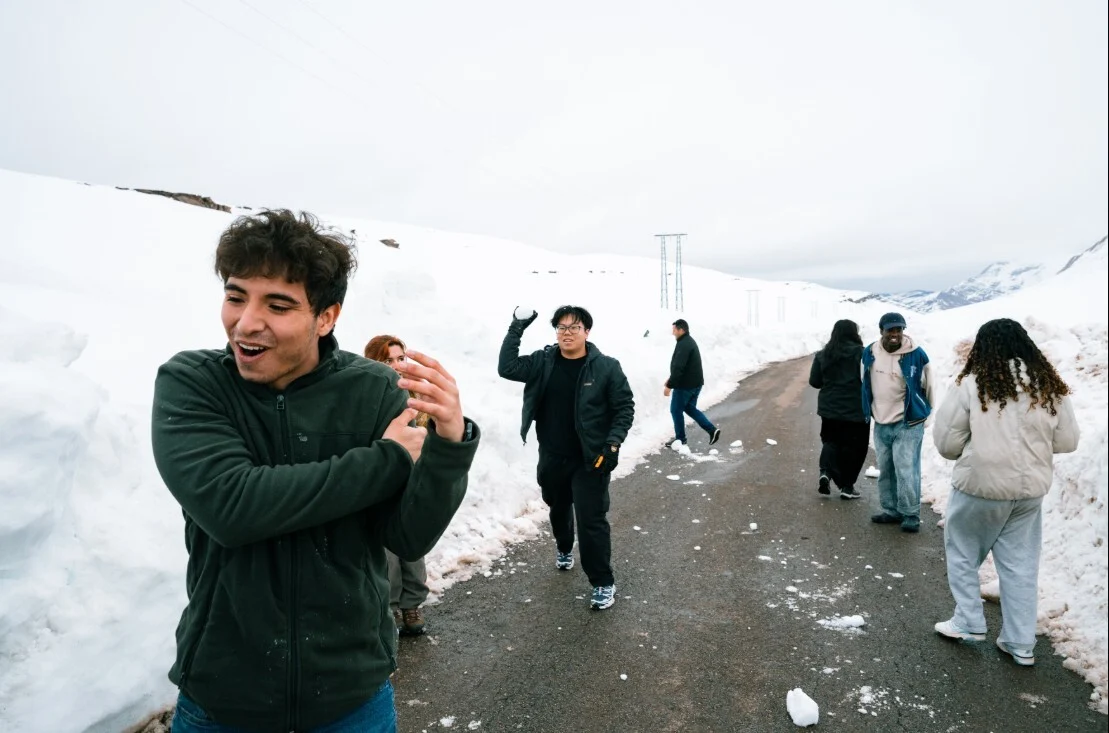
The landscape was not the only thing our Scholars were struck by: they were also struck by snowballs!
“We were driving through the most snow I’d ever seen,” Isabella said, “and I was like, ‘Guys, just get back in the car.’ But then we stopped in the middle of the road and had a snowball fight. And it was great.” “That was really fun,” Ahmed agreed.
Beginning in Zawiya Ahansal, a nomadic commune of over ten thousand people, they learned about the region’s biodiversity – blessed at this time of year with a staggering amount of snow, among the coniferous forests – and immersed themselves in the culture of the Imazighen people, North Africa’s indigenous communities.
Sofia met with the women from a weaving group. Sofia’s interests are in part anthropological, and she observed a culture that was patriarchal–but within that structure, she saw women finding ways to be free and find community, for example, through a weaving group: “They had to get their husbands’ approval to join. But it became a way to earn income and to have a life beyond just being a wife and mother. They lived in the same tiny village, but before the group started, they only knew each other from saying hello. Now they share their lives together. It was quite moving.”
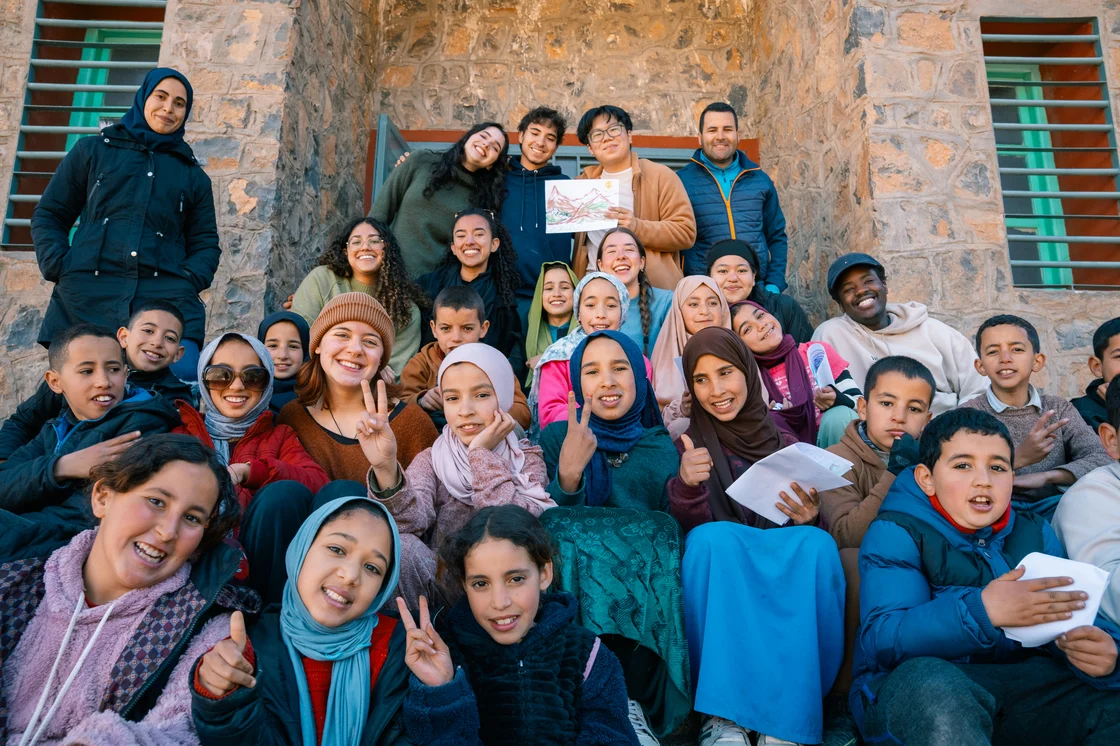
With the guidance of the Atlas Cultural Foundation, our Scholars engaged, in addition to the weaving workshops, in language exchange, cooking, gardening, and teaching. They learned some Arabic, and in the village school, Scholars split into groups — art, English, games, and environmental lessons – to teach.
Sofia worked with the students on their English. “We taught nine-year-olds the words for the parts of the body. I was jumping up and down trying to get them engaged.”
Ahmed and Isabella were in charge of art: “We did origami frogs and asked them to paint their homes — what they liked most about them,” Isabella said. “It felt like we were giving back.”
Ahmed felt entirely immersed in the experience: “When you’re in that moment, it just becomes the world. I was so focused on doing everything I could to make sure they were having a good time.”
In a year where they are learning so much, this was an opportunity to be the teacher. “We go to all these places and take a lot in — we’re learning a lot. But this was a moment when we gave back. We were leaving them with memories. It was a really sweet thing.”
From there, they continued on to Taghia, a remote village set in a gorge, a destination for ambitious climbers. Marrakech had been so loud and bustling, even after Istanbul, that Sofia was almost shocked by the quiet: “Within two days in the mountains, it wasn’t loud anymore. You could hear crickets. You could hear your own breath.”
There was, of course, a hike – to a waterfall, no less. The hike was much longer than some of the Scholars anticipated, rugged and cold. It was a moment where the Scholars needed to persevere.
“It was freezing,” Sofia said. “We had to cross a river, and our guide was like, ‘Take off your shoes.’ By the time we got back, my leggings were soaked, and I was full-body shivering. I couldn’t decide if it was the cold or the excitement.” It’s moments like these that take our Scholars out of their comfort zone and ask them to bond.
They were rewarded with a stunning view from the top of a waterfall.
On their second-to-last night, they climbed onto a roof and stayed for hours.
“I have never seen a sky as clear as that,” noted Ahmed. Sofia agreed: “We were looking up at the constellations and could literally draw them out because the sky was so clear. I’ve never seen anything like it. You actually feel so small.” A microcosm of the Baret year: stunned by the vastness of the universe, of which our planet is just one small part, our Scholars become grateful for all that can be learned and done.
On their last night, they got together with the village for one last party. Their send-off included traditional Ahidous music and dancing with local musicians.
“They threw a party for us. Everyone we had met in the village came to dinner. It felt like the relationships we formed were meaningful,” Sofia said.
“There was henna, a live band, and traditional dress. You were shoulder to shoulder with them, moving slowly in a circle, and the music was so loud and so good. I just couldn’t stop smiling. My cheeks hurt from smiling,” Isabella added.
Because the Scholars had spent time in the village, helped out, and gotten to know its sheikh, they felt welcome, like they were a part of the community.
As our Scholars moved through the world, they become a part of it. It’s not only a matter of showing respect for the cultures they learn about, but about making connections, any of which could last a lifetime. As Ahmed put it, “I think Morocco definitely changed me. It shifted my mindset — I want to be more outgoing. I’ve tried so many new things I would’ve otherwise thought weren’t for me. It was a real epiphany.”
This is the power of a Baret year – in one short week, our Scholars do not just go on a journey across three biomes, or a journey across time and across cultures – their lives are changed. They find new reservoirs of strength and resilience that they weren’t able to access before. And they take that resolve forward with them into the rest of their lives.

NEW YORK
SAO PAULO
PARIS
ISTANBUL
NAIROBI
DELHI
BEIJING


