

November 19, 2025
.jpg)
Our Scholars are lucky enough to get to travel the world with a renowned Art Historian. With a PhD in History of Art from UCL, Tom Snow has lectured at UCL and Sotheby's Institute of Art for seven years, and his writings have appeared in Art Monthly, Frieze Magazine, Third Text, Grey Room, and Afterall. He has even published his own book at MIT Press, Activism: Documents of Contemporary Art.
As a Baret Fellow, Tom is there to mentor our students and illuminate the historical forces and milieus that shape the art of each region they visit. They've made stops at, just to name a few, the Guggenheim Museum, MoMA, the Biennale de São Paulo, a host of NYC galleries, and most recently, the Louvre. Our conversation is below.
What drew you to Baret? What convinced you to join as a Fellow?
The simple and complicated answers are the same: to travel the world. My academic research interests are in art, visual culture, heritage and the history of ideas globally. Somehow, once I'd completed my PhD in London and lectured for about seven years, I began to ask myself the same question as when I was finishing my undergraduate studies. Why study the world whilst only being in a particular part of it? For me, experience is essential. Without it, I worry that my engagement with textual and visual material risks becoming a little tired and routine. With Baret, I'm seeing parts of the world again with fresh eyes, and other locations for the first time.
What compels you about being a Fellow? Tell me a little about your approach to teaching.
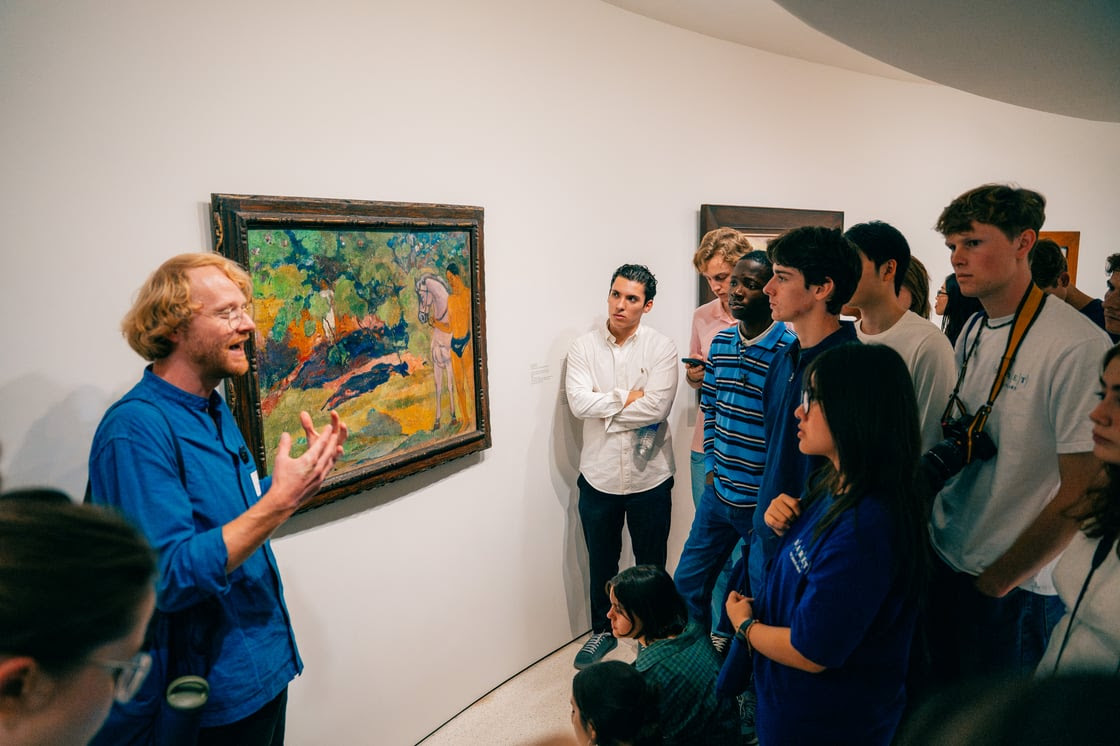
My approach to teaching has always been discursive and conversational. When I take Baret Scholars to art museums, gallery spaces, or cultural sites, the questions I raise are as much to the group as to myself. There is no substitute for standing in front of the artwork or in the environment that is under discussion. Even the most vivid representations have their shortcomings, unable to replicate the particularities of texture on a micro scale or affect on a monumental scale. Being in the presence of whatever it is that is being discussed allows its materiality to mold ideas. And if questions raised in the group are genuinely collective, then multiple pairs of eyes are better than one. I rarely come away from a discussion with our Scholars without having learnt something new.
In fact, standout moments so far on the journey have taken place in the most diverse group conversations, meaning that a group of scholars from varying different international and cultural backgrounds have contributed their personal experiences to the discussion. Take the international contemporary art exhibition, the Biennale de São Paulo, for instance. One student pointed out that a large-scale textile installation could simultaneously be read as a hammock or baby sling, which prompted various and meaningful comparisons about maternal nurture and cultural norms. I learnt more about the potential readings of the artwork and cultural codifications related to childhood that I didn't know before.
If you had one thing to tell young people who are interested in Art History, what would it be?
We live in an overwhelmingly visual world, whereby the vast majority of information that we consume on a daily basis is via images. Art History analytically surveys visual culture of the past in order to situate visual culture in the present. Sometimes it even points out how it could be better! We must know where we are coming from in order to have some idea about where we are headed. My view is that the world would benefit from a little more visual literacy as a basic skill.
What has been your favorite moment of the year so far?
It's early days. At the time of writing, we haven't quite finished region two. We have five regions to go. But I'll pick one: Anahuacalli in Mexico City was, for me, sublime. A purpose-built museum by the Mexican revolutionary and muralist, Diego Rivera, to simultaneously show his collection of pre-Hispanic artworks and make a case for the national character of independent Mexico. I am really keen on figures that use the nuances of the past to rethink the complexities of the present. What's especially great about Rivera's proposition is that he doesn't offer overly didactic statements, but rather raises possibilities. Regardless of one's knowledge about Amerindian histories, you come away with questions. What could be better?
What are you most looking forward to this year?
Difficult to say. How does one weigh up the known and the unknown? I'm looking forward to visiting all the places I haven't visited before! That said, India really stays with you. The colours, the sounds, the smells, the beauty, the problems. I haven't stopped thinking about returning to India since that last time I left. I'm curious to discover what's changed there, as much as in me. It's that kind of place. I guess, ask me again in a few months. I'll definitely have a different, if not more interesting, answer!
.jpg)

NEW YORK
SAO PAULO
PARIS
ISTANBUL
NAIROBI
DELHI
BEIJING


